
Mini sas cables SFF-8087 Working Principle
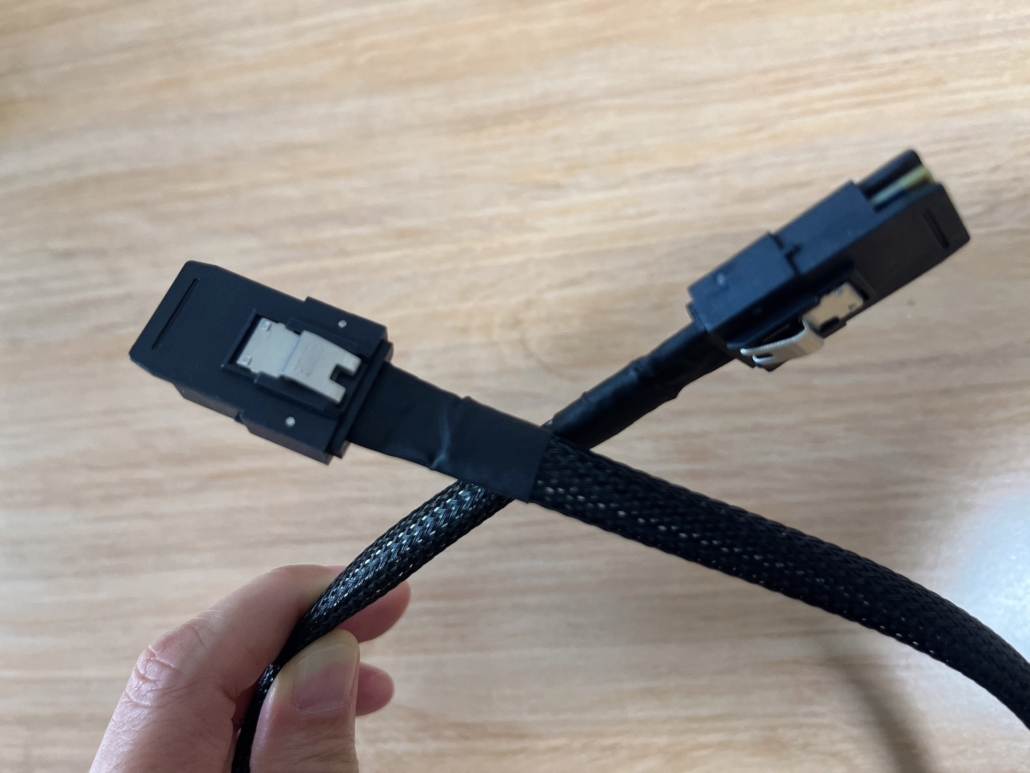
1. Mini SAS Technology Overview
The Mini SAS cables SFF-8087 Working Principle is the foundation of stable and efficient data transmission in modern servers and storage systems. By understanding the Mini SAS cables SFF-8087 Working Principle, enterprises can ensure reliable connectivity, low latency, and optimized performance for high-density applications. With advanced shielding and precise design, the Mini SAS cables SFF-8087 Working Principle delivers the speed and consistency required in today’s data-driven world.
Mini SAS (Serial Attached SCSI) is a high-speed serial interface standard used to connect servers, storage devices, and high-performance computing systems. It was designed to replace traditional parallel SCSI interfaces, improving data transfer efficiency and reliability through serial communication and point-to-point connections. The SFF-8087 is a common specification for internal Mini SAS connectors, supporting 4-lane data transmission and widely used for connections between server motherboards and hard drive backplanes
2. Working Principle of SFF-8087 Cables
2.1 Physical Structure & Pin Definitions
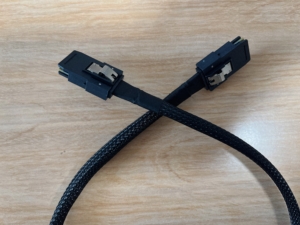
- Multi-Lane Design: The SFF-8087 connector contains 36 pins. Each lane consists of 4 wires (one pair of transmit differential signals Tx+/-, and one pair of receive differential signals Rx+/-), totaling 16 wires for 4 lanes
- Shielding Structure: The cable employs a parallel-pair design. Each signal pair is wrapped with an aluminum foil shield, and the overlapping rate (typically 30–40%) is controlled to reduce signal crosstalk
- Conductor Material: To minimize the skin effect in high-frequency signals, SFF-8087 cables often use tinned copper conductors, supporting data rates of 6 Gbps
2.2 Differential Signal Transmission
- Each lane uses two wires carrying opposite-phase signals. The receiver determines the data by comparing the voltage difference between the two signals. This design effectively cancels out common-mode noise, ensuring signal integrity
- Full-duplex communication allows simultaneous transmission and reception on each lane, enhancing throughput efficiency
2.3 Electrical Characteristics & Performance
| Parameter | Requirements & Description |
|---|---|
| Data Rate | Supports 6 Gbps (SAS 2.0 standard), with a total aggregated bandwidth of 24 Gbps for 4 lanes |
| Impedance Matching | Differential impedance must be stable at 100Ω ±10% to reduce signal reflection and attenuation |
| Attenuation Control | Uses physically foamed insulation materials (e.g., PP/FEP) to maintain a low dielectric constant, ensuring stability for high-frequency signals |
3. Workflow & Protocol Support
- Connection InitializationAfter power-on, the SAS controller identifies connected devices through the SCSI Management Protocol (SMP), negotiating data rates and lane aggregation
- Data Transmission
- SSP Protocol: Used for transmitting SCSI command blocks, ensuring compatibility with SAS drives
- STP Protocol: Provides a communication channel for SATA drives, allowing SAS controllers to manage SATA drives directly
- Data is transmitted in parallel through the aggregated lanes of the Mini SAS cable and re-serialized at the receiving end
- Error Handling & Hot-SwappingThe cable supports hot-swapping. The connector uses a plastic latching mechanism to prevent accidental disconnection. The cable’s shielding is grounded to dissipate electrostatic interference
4. Key Manufacturing Process Points
- Insulation Foaming Process: Cables for 6 Gbps often use chemically foamed polyethylene, ensuring a stable dielectric constant (foaming degree >45%
- Wrap Accuracy Control: The aluminum foil wrap overlap rate must be strictly maintained between 30–40% to avoid shield gaps that could cause signal leakag
- Thermal Setting: Uses a horizontal preheater to heat the self-adhesive polyester tape, ensuring the shielding layer is firmly bonded and preventing wire pair displacemen
5. Application Scenarios & Advantages
- Applications: Primarily used for internal server connections (e.g., HBA cards to drive backplanes) and storage array expansion
- Compatibility: Can be backward compatible with SATA drives, though requires protocol conversion via STP
- Advantages: Full-duplex communication, high aggregated bandwidth, strong noise resistance, and a more compact design compared to external cables (e.g., SFF-8088), saving space inside chassis
Summary:
The Mini SAS SFF-8087 to SFF-8087 cable enables high-speed, reliable data transmission through differential signaling, multi-lane aggregation, and full-duplex communication. Its performance heavily relies on key technical parameters such as conductor material, shielding craftsmanship, and impedance matching. During production, strict control over wrap precision and insulation consistency is essential to ensure signal integrity meets the SAS 2.0 standard requirements
The Mini SAS cables SFF-8087 Working Principle ensures stable high-speed data transmission for servers and storage. With optimized shielding and low latency, the Mini SAS cables SFF-8087 Working Principle provides reliable connectivity in enterprise applications. Choosing our solutions means understanding the Mini SAS cables SFF-8087 http://www.wahsondg.com Working Principle for performance, compatibility, and long-term efficiency.


Leave a Reply
Want to join the discussion?Feel free to contribute!